
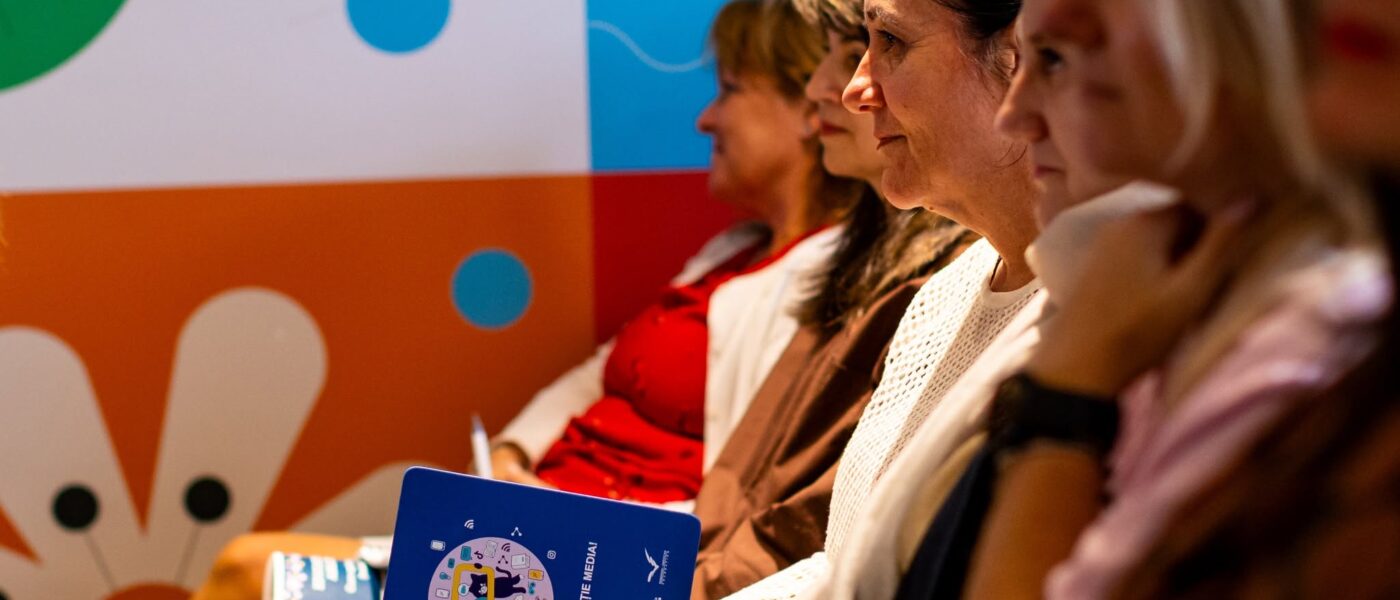
The Digital Media Literacy course at the end of the 2025-2026 school year
Over 800 teachers graduated from CJI’s Digital Media Literacy course this school year and learned how to tell facts from opinions, how to check the information around them, and how to carry media literacy further into their own classrooms and subjects.
We had both high school and middle school teachers participating in the course, teaching subjects from the language and communication curricular area, as well as the humanities and social sciences area. At the end of the first media literacy summer school for teachers we had 30 teachers with us; by the end of this school year, that number has grown to nearly 2,000.
Program growth
When people hear about a course dedicated to media literacy, many picture a course focused on developing digital skills.
In reality, the course helps teachers understand how the media universe works as a whole. And the first step we take is in understanding this media universe: what it it’s made up of, and how we relate to it every day. We start with traditional types of media, from newspapers and books, and move on to social networks and the interactions we increasingly have with chatbots and artificial intelligence.
Teachers learned about active and passive consumption, and how to reflect on their own media consumption. “The biggest challenge was monitoring my own media consumption and realizing I spend more time on my phone than I initially thought,” one teacher told us.
At the same time, many of them say that one of the most appreciated parts of the course is the one dedicated to checking information, which is, in essence, a critical thinking exercise that they then pass on to their students.
During the course, teachers learned the difference between misinformation and disinformation, how to identify signs that a message may not be trustworthy, and how to understand and explain the mechanisms and purposes behind such messages.
I learned to check sources and more easily identify fake news or manipulative information online. (…) I discovered useful apps and methods for checking information, creating content, and communicating effectively online.
Beyond the digital media literacy concepts taught, the course is built on dialogue and the sharing of participants’ experiences, as well as on participants working together and developing exercises for their students in team activities.
And because each cohort of teachers is different, we also learn valuable information about how their students relate to the content they access online, and what their sources of information and opinion-forming are. Building on this, teachers learn to adapt the media literacy concepts presented in the course, in order to help shape generations of young people who will look at the world around them with a critical eye.
How can media literacy be integrated into geography classes? One of this year’s course participants tells us:
Many students use maps, satellite images, or demographic data from unverified sources (e.g. social media, blogs). I’ll be able to apply fact-checking techniques to assess the credibility of thematic maps (for example, maps of population, climate, or natural resources) and to teach students to tell the difference between an official map and a fake or outdated one.
And in the end, they tell us that beyond the knowledge and practical tools, the course also changes how they approach their own classes: “I had been missing a course that encourages participants to see things differently than before the learning process, so I gained a lot of knowledge, learned from many good-practice examples, and built up the courage to create special, relevant lessons for my students.”
I’ve already told my students about this course. I’m trying to combine what I learned with the lessons from the textbook, and I’m sure that this way I can speak my students’ language, which means I’ll design more engaging lessons.
I’m starting to see that a lot of my life is directly or indirectly connected to digital media. What’s left for me to do? Educate myself and help educate as many people as possible on this topic.
At the end of the course, we asked teachers which topics they’d like to explore further in CJI’s webinars. Many said they’d like to learn more about artificial intelligence and the challenges of using it, as well as about fighting disinformation and checking information online, and about using artificial intelligence in education and journalism — increasingly relevant topics today.
The Media Literacy Program, from 2017 to today
The course is part of the Media Literacy Program of the Center for Independent Journalism. The digital media education training program for teachers is carried out by CJI as part of the project “Digital Media Education for Young People in Romania,” funded by the Fondation BOTNAR, coordinated by CJI, and implemented in partnership with Ashoka Romania, E-Civis, EDUMI, Funky Citizens, and Grupul PONT. The training program is also co-financed through the BROD project (Bulgarian-Romanian Observatory of Digital Media).
The BROD project (Bulgarian-Romanian Observatory of Digital Media) is funded through the European Union’s Digital Europe Programme, under contract no. 101226153.
