Caught between prejudice and ignorance: The representation of mental health in the Romanian media in 2025
In the 365 articles analyzed, mental health experts are rarely mentioned, and the terms used in many of the articles contribute to the labeling and stigmatization of people suffering from mental health disorders.
"Why is the way the media addresses mental health important? The media can put issues ignored by politicians on the public agenda, it can put pressure for change, it can expose abuses, it can give a voice. But the media has another role. It can isolate the issue of mental health if it chooses to ignore it. At the same time, it can lead to stigma and prejudice if it treats it superficially. But a balanced, responsible approach can foster empathy and healing."

More than half of the articles analyzed bring up the topic of mental health after a specific event occurs, whether it be a possible suicide or the release of a documentary about teenagers.
In less than half of the articles, the goal is prevention, and most of the time these are included in the health section, and the authors do not mention the studies they refer to and do not cite the names of the researchers they invoke.
"365 articles in two months from 12 daily publications, of which 113 are only tangentially related to mental health, is not much. And it is insignificant if we compare this number to the challenges Romania has faced in recent times, and some it still faces—the pandemic, war at the borders, a year of election campaigning, economic crisis, and austerity measures."

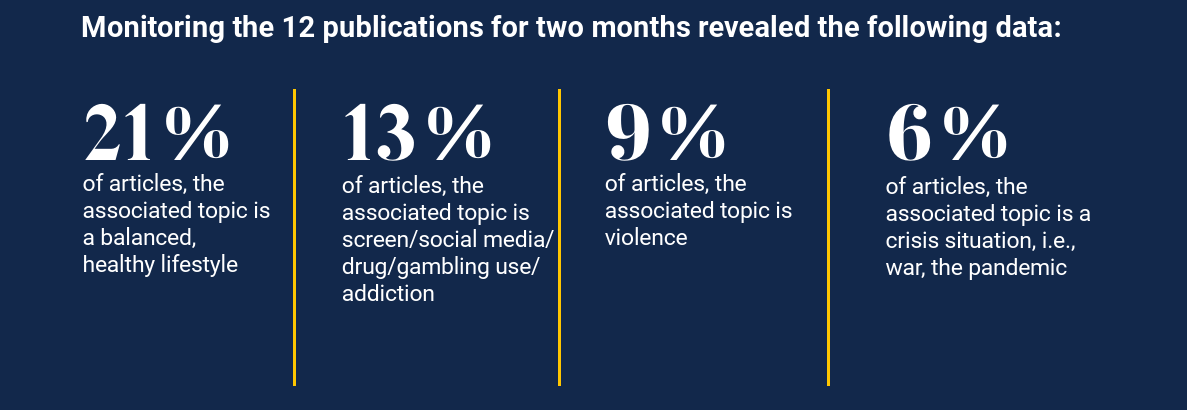
Because the press writes little about mental health, it is very important to see what topics bring mental health into discussion, what kind of topics are associated with the theme.
Articles in the prevention area mostly concern journalistic material included in what we call the Health category/section. Depending on the website/platform, it is called: Lifestyle, Health, Mind and Body, Health and Relationships. In many of these articles, the authors do not mention the studies they refer to and do not cite the names of the researchers they invoke.
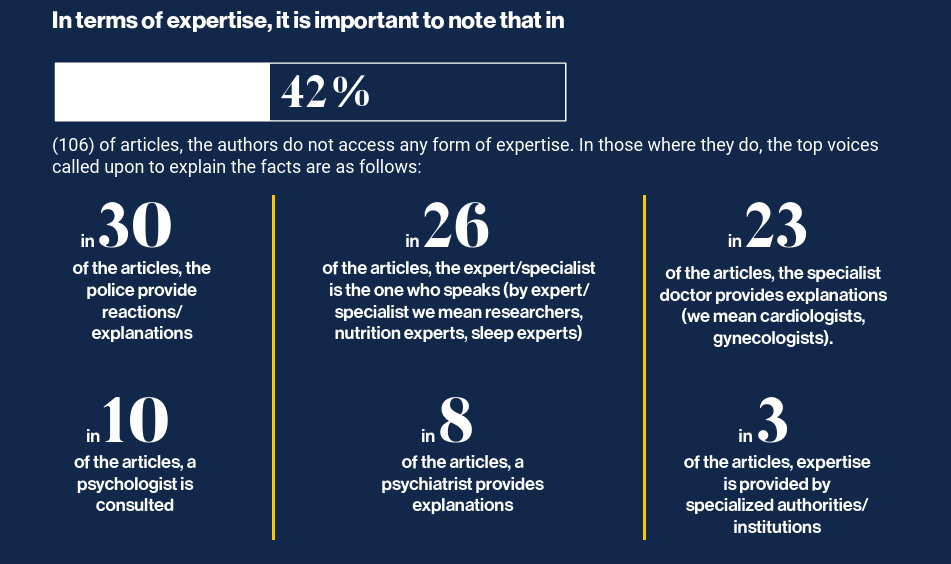
The monitoring shows that, in the case of expertise, in 42% (106) of the articles, the authors do not access any form of expertise.
The qualitative analysis of the research includes interviews with journalists from the monitored publications, from the independent press, and also with mental health specialists.
In order to report on difficult topics in an empathetic way that helps reduce stereotypes, we need journalists who take care of their own mental health first and foremost.
”I think the media needs to normalize this discussion about going to a psychologist, about taking care of your mental health, because it’s like, I don’t know, washing your hands or going to the doctor because you feel sick.” says Carla Tănasie, Digi24 reporter.
Mental health care is essential for journalists who cover topics such as violence or human trafficking. In such situations, reporters often come into contact with vulnerable people, and the way they interact with them must prevent retraumatizing.
Awareness of the importance of mental health among journalists should not remain only at the individual level. Newsrooms and their leaders must recognize this need and implement tangible support measures.
Despite some lingering prejudices, Vlad Stroescu, psychiatrist since 2004, believes that the press have made many strides, albeit slow ones, in recent years. What progress has he observed specifically?
- greater care when it comes to suicide stories, including mentioning the measures someone can take, the numbers they can call if they feel in danger
- reporters at psychiatrists’ conferences
- better reporting of scientific progress
However, beyond all this progress, sensationalism remains. But also a tendency toward “the irrational, the superstitious, conspiracy paranoia, in a highly political or politicized context.” This inclination, the doctor observes, is not limited to part of the press, but also extends to part of social media and the public.
The quantitative analysis also focused on mental health in children and adolescents. Florina Rad, a senior pediatric psychiatrist, believes that the main effect of stigmatization is fear, parents are afraid of everything related to psychiatry:
“We have many parents who refuse help, who, even if their kids end up, say, in the emergency room, refuse hospitalization because they do not want them to be admitted to ‘such a hospital’. That’s how they put it: ‘such a hospital’. This is somewhat painful for us, because ultimately mental disorders are disorders like any other. They are no more shameful than somatic disorders.”
Florina Rad, head of the Pediatric Psychiatry Department at Obregia Hospital, provides an example of the important role the media can play in reducing stigma and in the psychoeducation of adults and adolescents. She recounts in the interview from the research that she faced a large influx of patients because parents had read and identified with certain experiences described in an article about a teenager with Asperger’s, which recounted the experiences of the child, the parent, and the doctor’s perspective.
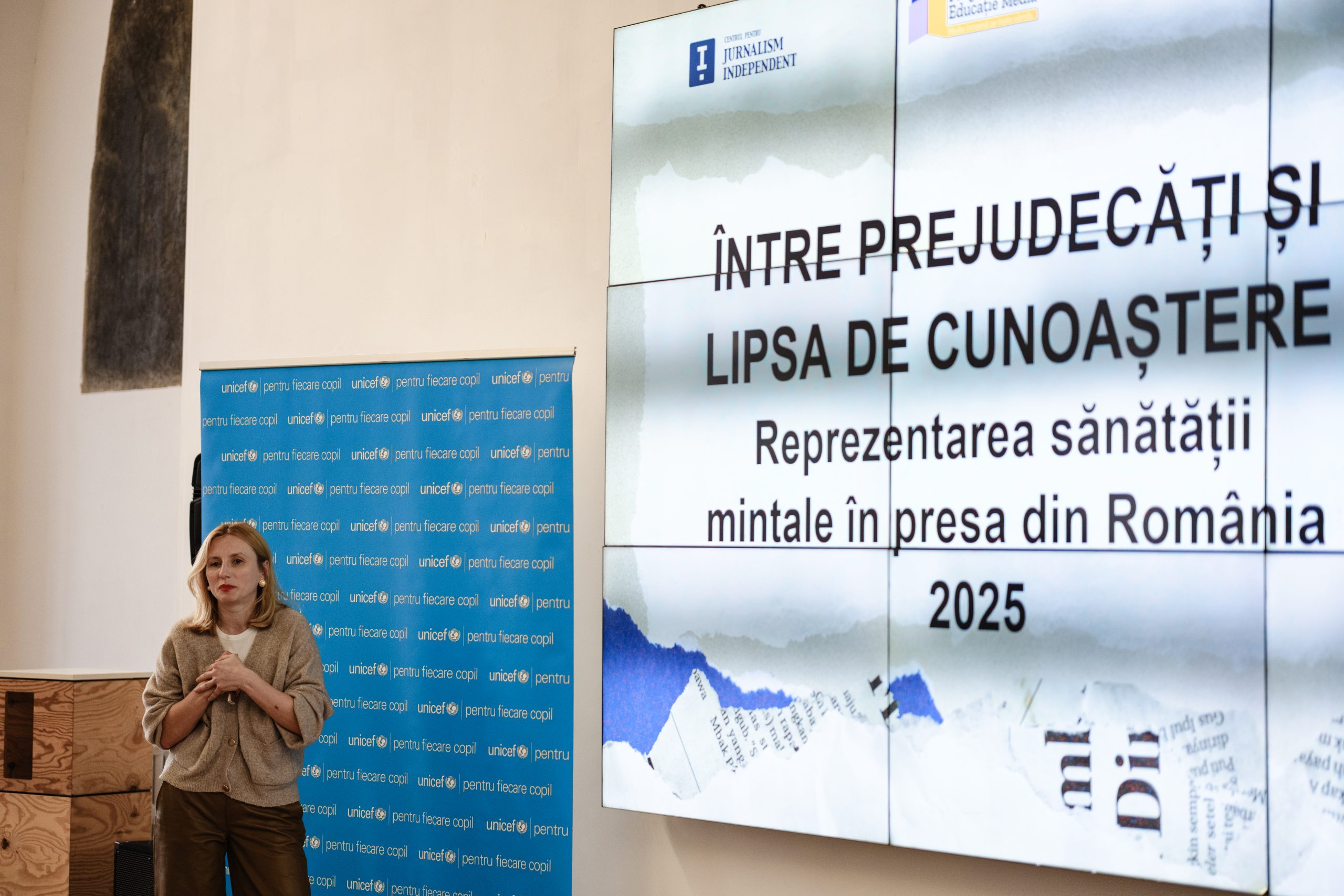
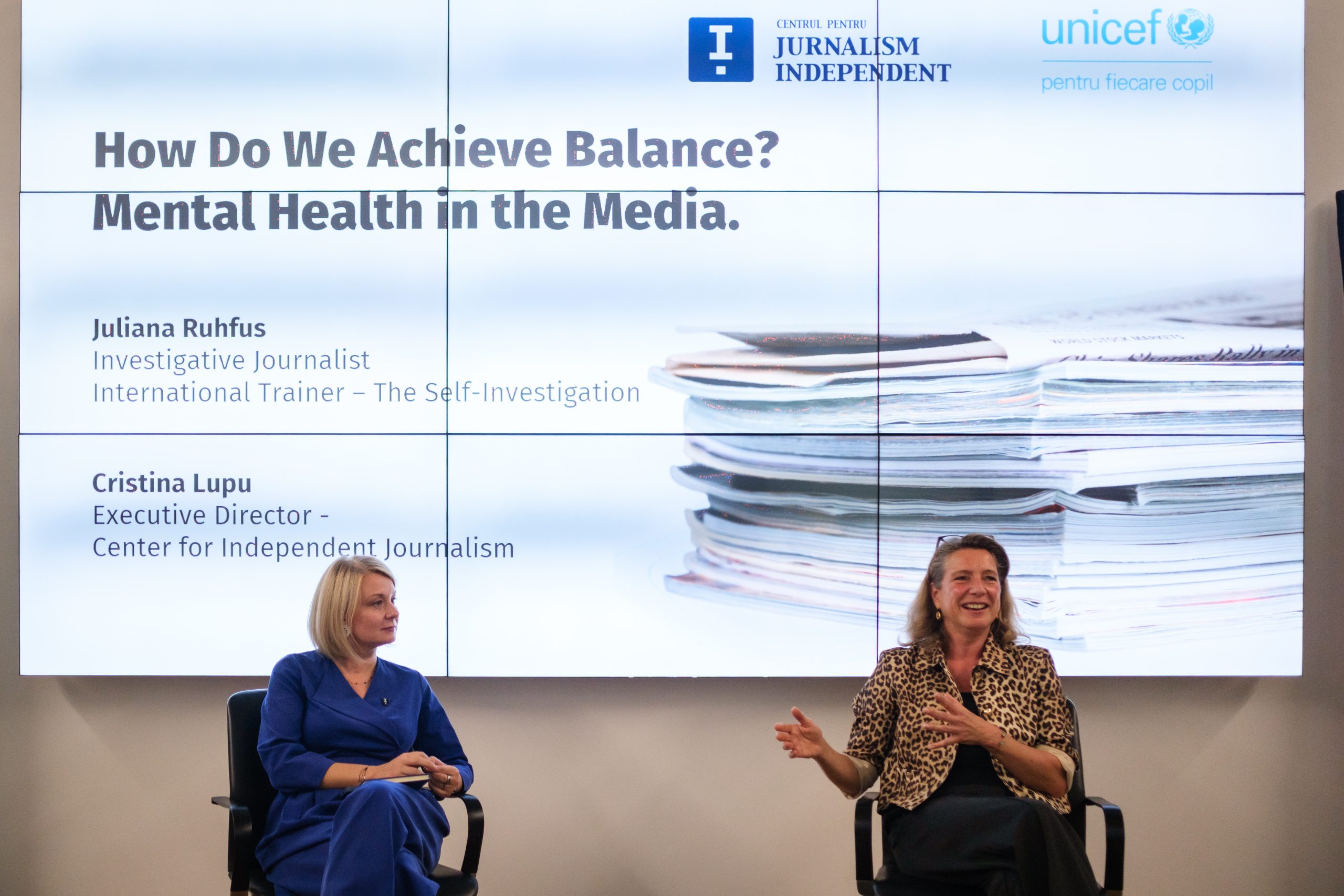
Photos taken during the research launch: “Caught between prejudice and ignorance: The representation of mental health in the Romanian media in 2025.”
📸 Photo credit: Nechez Alexandru
The research was conducted by the Center for Independent Journalism (CIJ) as part of the Media Education for Mental Health project, with the support of UNICEF in Romania.
The initiative also aims to improve the competences of journalists, future journalists and communicators in covering sensitive topics related to mental health through training programmes, mentoring and fellowships. As part of the project, four journalists or teams of journalists received fellowships and support from an experienced editor to document and publish journalistic material relevant to their communities. More about the project at cji.ro/en.