
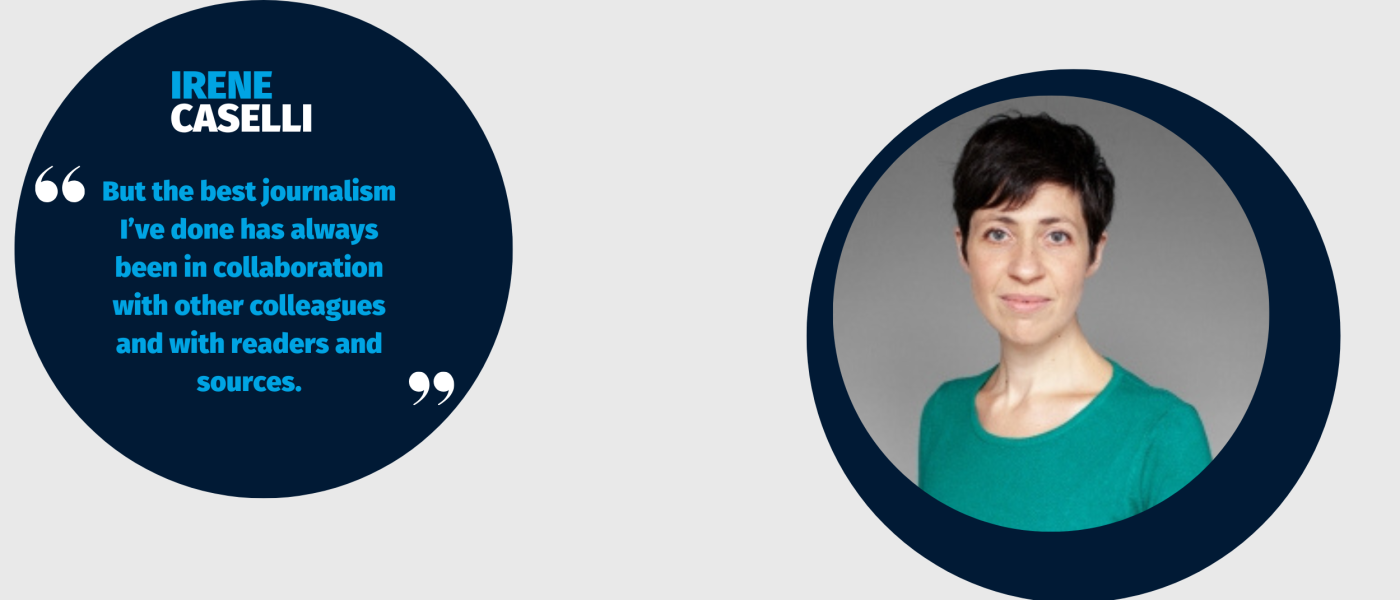
Irene Caselli: “I try to create bridges so that people feel less alone”
Irene Caselli is a multimedia reporter and writer with 20 years of experience in radio, television and print media, and for 10 years she was a correspondent in Latin America for the BBC, Washington Post, The Guardian and The New York Times. In 2019, she started reporting on early childhood for The Correspondent, until it shut down at the end of 2020. In January 2021 she launched her newsletter, The First 1,000 Days. Her current concerns include early childhood, reproductive rights and caregivers. Caselli is a Senior Adviser for the Dart Center for Journalism and Trauma.
From 25 May to 27 May Irene was at the Centre for Independent Journalism as a speaker for the workshop “How do we report with empathy and accuracy on sensitive topics?”. We took advantage of the fact that she was our guest and talked with her about what motivates and discourages her in the work she is doing, about the ways to deal with secondary trauma as journalists and about what’s happening at the Dart Center.
On representing realities of your community
“You can’t talk about children without talking about equality, caregivers, reproductive rights,” Irene told us in one of her talks during the workshop. Her reporting is not only about children, but also about human rights and the policy changes needed in everything that regards children and their families or caregivers.
But Irene was not preparing to become a journalist. In 2001, while she was studying international relations and German language and literature in Scotland, she witnessed the anti-globalization protests following the G8 meeting in Genoa. She saw how the violence of the police on the demonstrators was not covered properly by the media. That was the moment Irene started questioning the way the media should function.
“And so later when I graduated, I found myself in Chile and I started interning at an English language newspaper in Chile. And something really clicked, hey, you can become a journalist and represent realities that aren’t usually represented right by the media. I didn’t have it so clear when I started up, but there were a lot of things around me that were suggesting that some parts of our realities weren’t being described properly, or weren’t explained properly. And I felt that there was almost a necessary role to become a witness to those realities that weren’t properly represented and to try to change that. Those realities were mainly injustices or human rights violations, vulnerability, poverty. Those things have always been on my mind most. And that never changed.”
But it wasn’t smooth sailing from then on
In her early career as a journalist, Irene was a correspondent for the BBC in Venezuela in 2013, during violent times following president Hugo Chavez’s death. She was reporting daily about the protest and the violences in the country.
”I really started asking myself, what am I doing, where is my role here? Am I really just supposed to say hey, one side says this, the other side says that, is that the way that we really do journalism? And at some point I didn’t think I could do that anymore and the situation in Venezuela was becoming growingly difficult. And so I decided to leave the country. I realised that breaking news was really not what I wanted anymore, because I just didn’t really have a way to understand the story more fully, and I thought that was probably dangerous.”
A different type of NGO-s
So what do you do when you are at the beginning of your career and you feel disappointed, when you think about giving up? When you are sceptical that your articles will actually bring a change in society and when you are afraid that the injustices you report on will remain as such?
”First of all, not every article we write can change the world. If it were like that, it would be weird. So I guess my first piece of advice is this: don’t think that every article you write is gonna create policy change, but think that maybe there are other changes that are not so obvious and evident, that are actually happening, that you’re not able to see until you keep monitoring over a longer period of time.”
It’s not always about creating policy change, many times it’s about the small steps journalists take in the long run. “If we are on the same stories around, for example, child poverty, we may be able to then get to know the NGOs well, and then maybe we create bridges between vulnerable populations and NGOs in a way that wasn’t available before. So yes, we’re journalists, we’re not activists, but we can also become actors in the wider story in a way that we may have not thought about in the past because we always have this feeling that we need to be neutral and not involved, though we’re not neutral.”
“We need to make sure that we’re well in order to report things well”
During the three day workshop, secondary trauma, which is a type of indirect trauma, suffered by those that hear about the traumatic experiences of others, was a central topic of the discussions. Most of the journalists participating in the workshop had been reporting on Ukrainian refugees in the past year, so different types of coping mechanisms and self-care tools were brought into discussion.
“I guess I would be very careful when it comes to a mental health perspective, sometimes covering these issues and covering them over a long period of time, let’s say violence against children, or covering the lives of people that live in vulnerability can really affect us, it can create what we call secondary or vicarious trauma. And sometimes we start normalising the fact that we have nightmares or that we are not sleeping well, or that we feel sad or that we feel angry. But actually these are often signs that we are traumatised ourselves and that we need help.” Therapists and any other form of support are beneficial, but we first need to become aware of our need for self-care, “we need to make sure that we’re well in order to report things well”, Irene explains.
During the interview, Irene holds her baby or goes to get him from the floor after the few steps he’s managed to make. ”So my children are definitely a way that helps me kind of disconnect from work. Another coping mechanism is definitely therapy. I’ve been doing therapy for over 10 years and I’m now just changing the type of therapy. I always have a therapist and I feel that it’s very much needed to have a professional accompanying me personally. Also because oftentimes I feel that we may become attracted to certain types of stories or reporting because they have a deeper meaning for us in our personal life. And while that’s great because it takes us closer to the sensibility that we need to have, the sensitivity that we need to get close to sources, it can also be a big trigger for us. And then I try to think of the bio-psycho-social aspects1 as we were looking at yesterday. So I try to take care of my body. So I do yoga whenever I can, I do run whenever I can, I try to spend a lot of time outside, away from screens. I try to have a pretty strict routine with my phone. So there’s no phone when I’m eating, there’s no phone like an hour before I’m going to bed, there’s no phone for an hour after I’ve woken up, until I’ve had breakfast. I’ve taken away all social media from my phone. I’m trying to choose the times when I get access to news. And to social media.”
Reporting as a parent
However, reporting on children is not easy, especially when you have your own children back home, or when you carry your child around while interviewing mothers who raise their children in prison, as Irene did while working on her story Babies Behind Bars: Children Serve Time with Mothers in Mexico’s Prisons, in 2018. Irene’s children are a way to disconnect from her job, but they also change her perspective as a reporter. ”I often feel guilty, like when I go into refugee camps and I see a mother whose child is the same age as my child. That’s very hard.
Parent or not, reporting on children comes with an emotional burden, and there are moments when this emotional burden makes it hard for you to continue to do your job. Irene told us about such a moment when she was supposed to interview a pregnant migrant woman from Liberia, rescued from a sinking boat close to the coast of Italy.
”And actually once I really lost the plot. She was excited about her pregnancy. And I went to interview her. And when she told me she was pregnant, I couldn’t focus on the interview anymore. And all I could think was I need to get this woman some pregnancy pre-birth vitamins. That was all I could think about, I need to help this woman. I’m a journalist. I can’t really help. Like, what am I gonna promise? But I went to the closest pharmacy and I came back with like two boxes of pregnancy vitamins and I told her to take them on a daily basis. And then I had to leave. So yes, it can be difficult to have your own child because you’re constantly comparing and you feel guilty. That’s something that I discuss in therapy a lot.”
Irene says that in her newsletter, The First 1,000 Days, she gives up on journalistic neutrality and becomes personal and transparent, while taking advantage of the insights that she has as a mother. ”It can also be important because since I cover children, I understand a lot of the issues that I probably didn’t understand before becoming a mother. And then sometimes, also in my newsletter, I go from the very sort of personal observation as a mother to my reporting. And so it can be a strength, it can be a weakness as everything. And sometimes it’s hard to balance the two, but I try to be very transparent about it with my readers, at least when I write in my newsletter.”
Connecting journalists
Irene applied and was accepted for a Dart fellowship in 2018. During our workshop, she spoke about the way the research made by her colleagues on brain development in the early life of a child and long-term impact of trauma on children have influenced the way she reports ever since she joined the Dart Centre. Now, as adviser and story coach for Dart, she says that she tries to be a peer with whom the journalists she works with can talk to and have regular deep conversations with. She tries to be present and to be the mentor she wished she had had.
“So as part of the DART Center, we often have fellows from different parts of the world working on similar issues or similar stories. So I try to connect them and I try to make sure that at least they’re aware of what’s happening elsewhere in the world. Because I think that sometimes we become very compartmentalised. Because we’re working for a certain audience in a certain language and it’s hard to think about what’s happening in the rest of the world. But sometimes when we look at reports from other parts of the world, we may understand that maybe there’s a solution that happened elsewhere that may be relevant for us or maybe another colleague has had access to studies elsewhere and then that’s relevant for us. So I try to create bridges so that people feel less alone. I believe overall, as journalists, we have this old school kind of form of journalism. It’s all about competition and who gets first to the story. This is still the reality in wires, for example. But the best journalism I’ve done has always been in collaboration with other colleagues and with readers and sources. Because I’m only one person, one white woman from a Western European country with a privileged passport, with a certain view, with two eyes and one brain. But if you get together with another journalist, then it’s a really doubled capacity. You got four eyes, two brains and so on and so forth.”
Even though, or maybe because Irene has lived and worked in different countries, her views are always centred on connections. The connections journalists create between authorities and those poorly represented, between journalists and the people they report about, as well as those between journalists. ”So I really hope that what I can bring to other journalists is this idea that collaboration is important, that we need to stop thinking in very kind of traditional school ways and we need to collaborate more. We need to be more transparent about how we do things, about what we feel. We need to be more open with our sources and with other journalists and this is the only way that we can really go forward and create change.”
Interview by Veronica Lungu
1Biological, psychological and social aspects which are analysed in order to offer a model of wellness and health.
